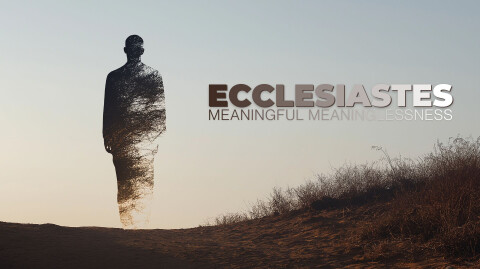
The journey into Ecclesiastes has begun. If you weren’t able to join us on Sunday, I’d encourage you to take a LISTEN to Sunday’s sermon, the introduction to the series — it sets the stage for everything we’re about to walk through together.
Over the next several weeks, well, as long as we’re in Ecclesiastes, I’m going to use this devotional space to dig a little deeper into themes I couldn’t fully unpack on Sunday. This book is dense, honest, and beautifully complex — and even though we only covered two verses this past week, we could easily spend the next month sitting with just one word: HEVEL.
So today, that’s exactly what we’re going to do — take a deeper dive into this word that sits at the front door of Ecclesiastes and shapes the entire book.
“Hevel” is one of the most important words in Ecclesiastes… and one of the most misunderstood.
Most English translations translate “Hevel” as “meaningless,” “vanity,” or “futility.”
But the Hebrew word is far more vivid and far more human than any of those translations can capture.
Hevel literally means… vapor, mist, breath.
Something you can see for a moment… but can’t hold.
Something real… but impossible to control.
Something beautiful… but gone before you can grasp it.
If you’ve ever stepped outside on a cold morning and watched your breath appear and disappear in the air — that’s hevel.
And Solomon says: That’s what life feels like.
Not pointless.
Not worthless.
Not empty.
But fragile.
Fleeting.
Uncontrollable.
Unpredictable.
A vapor.
When the people of God first heard Ecclesiastes, ancient Israel was living in a time of prosperity and peace under Solomon’s rule. This period was marked by significant cultural and economic development, including the construction of the First Temple in Jerusalem.
Ecclesiastes reflects the complexities of a society that, while materially affluent, still grappled with existential questions and the search for purpose beyond wealth and achievement.
So when Solomon — the man who had everything — stood up and said:
“I chased every version of meaning the world offers… and it all turned out to be hevel,” the people of God did not hear cynicism.
They heard honesty.
They heard someone finally naming the ache they carried.
They heard a king who understood their questions.
They heard the wisest man who ever lived give voice to their disappointments, their confusion, and their longing for something solid in a world that felt anything but.
Hevel wasn’t meant to depress anyone. Rather, hevel was meant to PREPARE everyone to receive a deeper, truer meaning — one that doesn’t evaporate like mist.
If we’re honest… and let’s be honest — WE FEEL HEVEL TOO.
We feel it when plans fall apart.
We feel it when joy comes in moments, but sorrow stays for seasons.
We feel it when success doesn’t satisfy the way we thought it would.
We feel it when relationships change, when expectations disappoint, when life refuses to follow the script we wrote for it.
We feel it when we realize we’re not in control — not of outcomes, not of timing, not of the future.
Hevel is the word that gives us permission to admit that life doesn’t always make sense.
And here’s the gift… Ecclesiastes doesn’t rush to fix that tension. Rather, the Teacher (that would be Solomon) invites us to sit in it long enough to learn from it.
Hevel teaches us humility.
Hevel teaches us honesty.
Hevel teaches us to hold life with open hands.
Hevel teaches us to stop pretending we’re in control.
Hevel teaches us to look beyond “under the sun” for meaning that lasts.
And ultimately, hevel prepares us for Jesus — the One who steps into our fragile, fleeting world and offers a kingdom that cannot be shaken.
I’m looking forward to walking slowly with you through this amazing book, trusting that the God who makes all things meaningful will meet us in the very places where life feels like hevel.